(Ishan Rai) Bhubaneswar, November 16: Emphasising the media’s pivotal role in strengthening democracy and shaping an informed society, Odisha Governor Brajmohan Ram on Monday urged journalists to uphold the highest standards of integrity, impartiality and social responsibility, asserting that freedom of expression must always be guided by truth, credibility and public welfare.
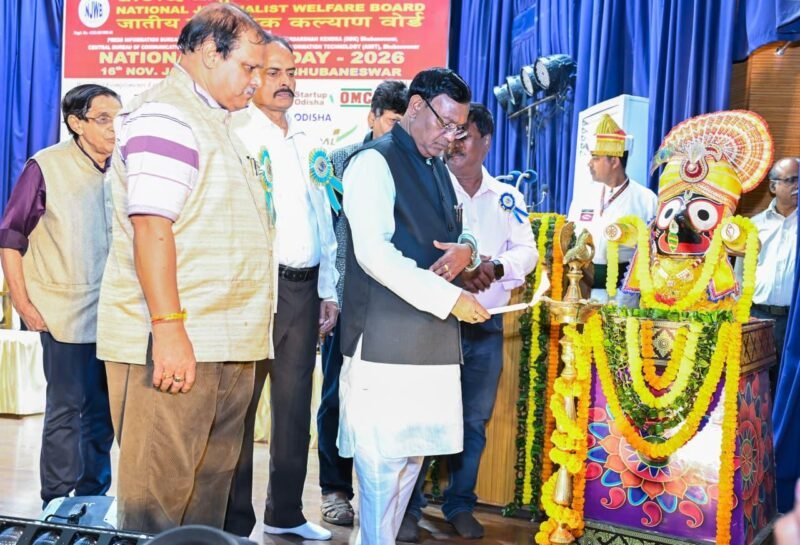
Addressing the National Press Day Celebration 2026, organised by the National Journalists’ Welfare Board (NJWB) in Bhubaneswar, the Governor said free, fair and fearless journalism was indispensable to strengthening democratic institutions and bridging the communication gap between the government and the people.
Congratulating journalists, editors and other members of the media fraternity, Ram said the media served as an important link between the government and citizens by disseminating information about government policies and welfare programmes while bringing public grievances, expectations and suggestions to the attention of the authorities. Such two-way communication, he noted, strengthened transparency, accountability and informed public opinion.
The Governor stressed that journalism should not be confined to reporting events but must also act as a catalyst for positive social transformation. He underlined that accuracy and credibility were as important as the timely dissemination of news, particularly at a time when digital platforms and artificial intelligence were rapidly transforming the media landscape.
Calling upon journalists to remain vigilant against misinformation and misleading narratives, he advocated greater emphasis on fact-checking, balanced reporting and the responsible use of emerging technologies.
Highlighting the media’s responsibility towards society, Ram urged journalists to generate greater public awareness about pressing issues such as substance abuse and drug addiction among youth, food adulteration, crimes against women, child labour, cybercrime and environmental pollution.
He also called for wider coverage of government initiatives in education, healthcare, agriculture, women’s empowerment, skill development and employment so that people, particularly those living in rural and remote areas, could access information about welfare schemes and their benefits.
Emphasising inclusive journalism, the Governor said the concerns and aspirations of marginalised communities, especially those residing in rural and inaccessible regions, deserved adequate representation in the media.
Appreciating the contribution of Odisha’s regional media, he observed that local newspapers and media organisations had played a significant role in preserving tribal traditions, promoting cultural heritage and highlighting rural life, besides drawing attention to the disaster-related challenges faced by the state.
Speaking on the occasion, National Journalists’ Welfare Board Chairman and Vice-Chairman of the Public Service Board Deepak Malavya said journalists worked round the clock, often sacrificing personal comfort, and their professional and personal difficulties needed to be brought to the attention of the government.
He stressed the need for government support towards insurance and pension facilities for journalists who had served the profession for at least 20 years.
In his welcome address, Board President Pradosh Pattnaik recalled that pension and insurance facilities for journalists had been introduced in the past.
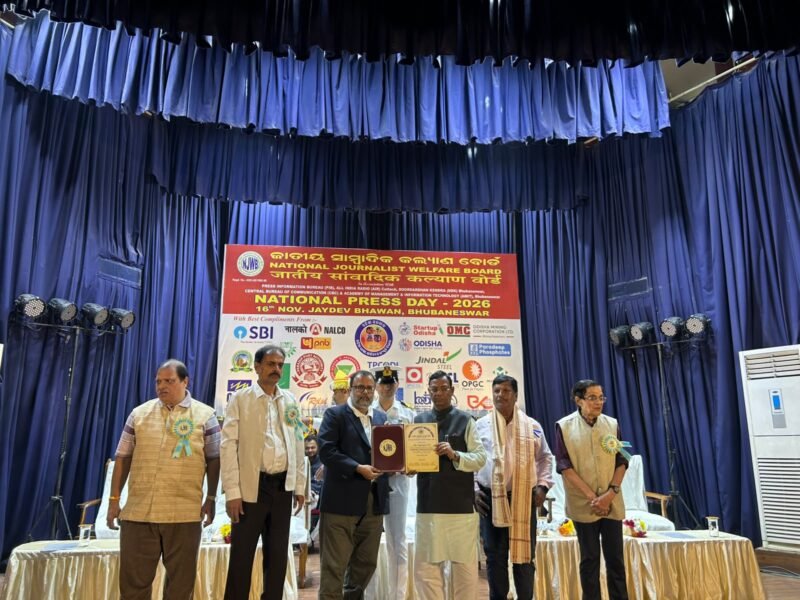
The occasion witnessed the presentation of several awards recognising outstanding contributions to journalism and media.
K. Ravi, Resident Editor of The Statesman, was conferred the Utkal Sambadika Samman Award 2026. As many as 32 senior journalists from Odisha were also extended pension benefits.
The National Journalist Excellence Award 2026 was presented to Nagaraju L.M., Managing Director of Bangalore Freedom TV; N. Srinivasan, Executive Director of Marudham Multimedia Limited, Chennai; V. Srinivas Reddy of Telangana Sakshi Publications; V. Shashibhushan Rao, Editor-in-Chief of a newspaper; and Chittradeep Chakraborty, Senior Assistant Editor of The Times of India, Kolkata.
Amit Singh, Head of Corporate Affairs at Vedanta Limited, received the Corporate Communication and Public Relations Award 2026.
Nine meritorious students who secured the highest marks in journalism courses during the 2025 academic year at various universities and autonomous colleges were also honoured with memorial awards instituted in memory of eminent journalists.
The award recipients were:
Uma Sumaya of Utkal University, Vani Vihar – Rabi Narayan Mohanty Memorial Award 2026.
Elina Mishra of Rama Devi Women’s University – Pradyumna Bal Memorial Award 2026.
Sushree Kalyani Jena of Ravenshaw University, Cuttack – Ram Hari Mishra Memorial Award 2026.
Ashish Kumar Pradhan of Berhampur University – Barendra Krishna Dal Memorial Award 2026.
Ananya Poddar, Odia Journalism student at the Indian Institute of Mass Communication (IIMC), Dhenkanal – Dillip Satpathy Memorial Award 2026.
Akhaya Kumar Hota of B.J.B. Autonomous College, Bhubaneswar – Arindam Das Memorial Award 2026.
Sabita Swain of Utkal University of Culture, Bhubaneswar – Gopal Mishra Memorial Award 2026.
Rishita Ray Choudhury of Fakir Mohan University, Balasore – Arun Panda Memorial Award 2026.
Priya Prakash, English Journalism student at IIMC, Dhenkanal – Dulal Mishra Memorial Award 2026.
Panel discussion explores popularity versus responsibility in journalism
As part of the celebration, the Press Council of India organised a panel discussion on the theme, “Journalism – Popularity or Responsibility?”
Participating in the discussion, Odisha Chief Information Commissioner Manoj Parida expressed concern over the credibility of domestic news coverage, observing that while information shared by foreign journalists was often considered credible, reports originating within the country sometimes became questionable.
Former Bureau Chief of The Times of India Rajaram Shatpathi pointed out that journalists working in media organisations often found it difficult to enjoy complete professional independence.
Former Information Commissioner Dillip Bisoyi remarked that the significance of news should not be judged merely by the incident itself but also by the people involved and affected by it.
Pitabas Mishra, Editor of the Odia daily Utkal Mail, said journalists should reach the scene of an incident, whenever possible, even before the police, while emphasising that the government must ensure their safety.
Utkal Journalists’ Association President Bibhuti Bhushan observed that popularity and responsibility were complementary aspects of journalism rather than competing ideals.
Senior journalists Ramesh Chandra Mohanty, Bhagabat Tripathy, Dr Krushna Chandra Bal and Suresh Chandra Mantri, along with noted social worker Vinod Kumar Baitha from Jharkhand, were among the other prominent participants.
Earlier, National Journalists’ Welfare Board General Secretary Sanat Mishra presented the organisation’s annual report, highlighting the challenges faced by journalists and placing various demands concerning their welfare. Vice President of the Welfare Board and senior journalist Pradyumna Kumar Mohanty proposed the vote of thanks.
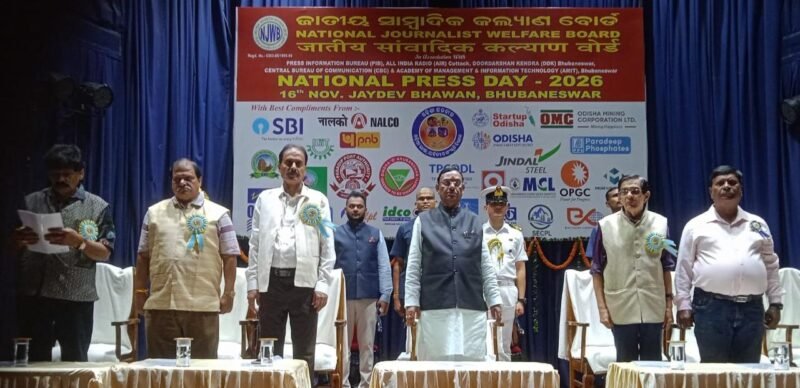
The National Press Day celebration was organised by the National Journalists’ Welfare Board in association with Doordarshan Kendra, Akashvani, the Press Information Bureau (PIB), the Central Bureau of Communication (CBC) and the National Institute of Mass Communication and Information Technology.